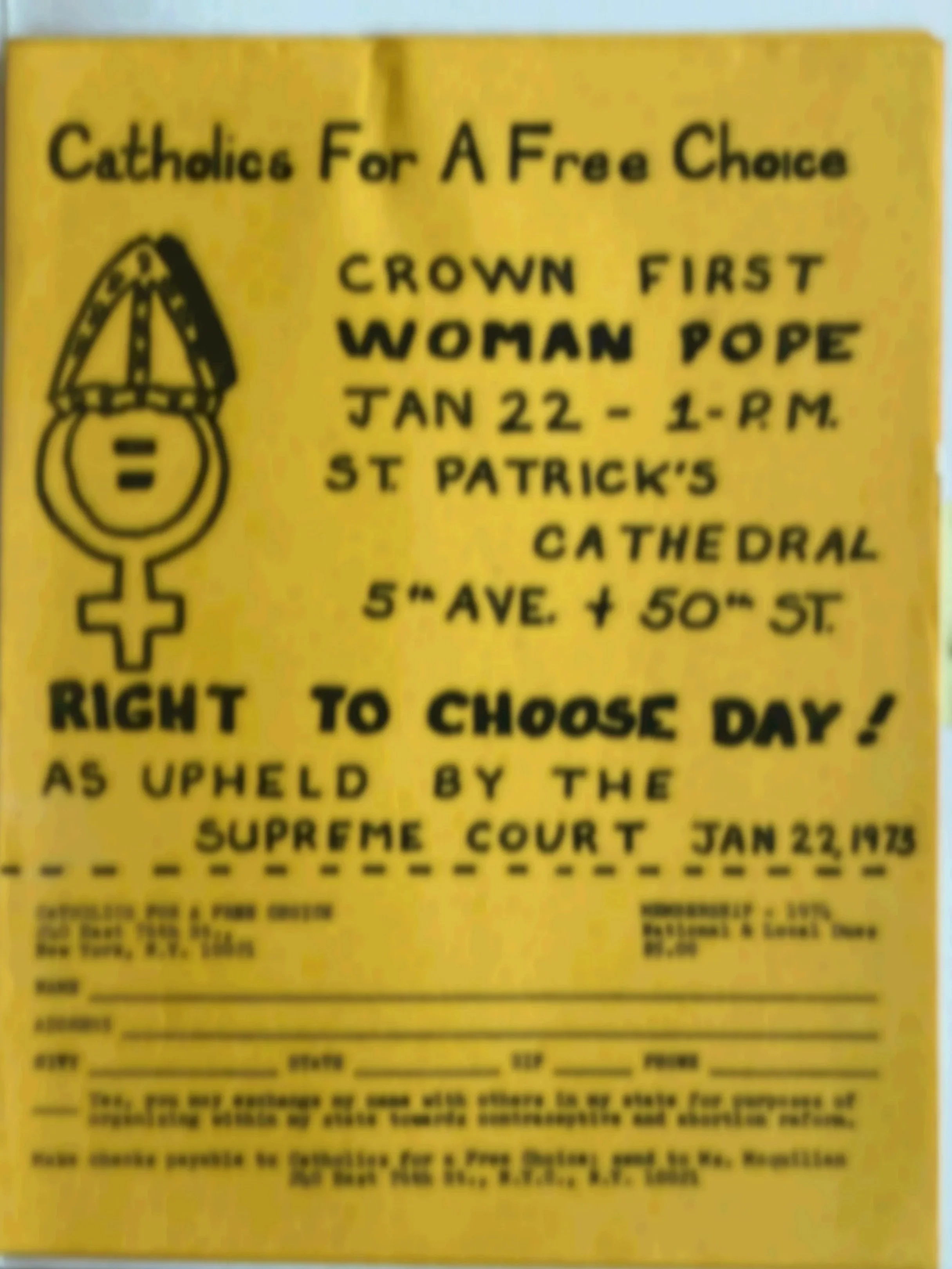
Catholics & Reproductive Justice
A Living History
Archive Coming Soon
•
Archive Coming Soon •
Abortion providers and clinic workers.
High school ethics teachers and campus ministers.
Personal accompaniers, abortion funders, and a former flight attendant coordinating a network of private pilots flying abortion-seeking patients across state lines.
These are some of the voices featured in Catholics & Reproductive Justice: An Oral History Project. This oral history project explores how those who self-identify as Catholic, were raised in Catholic families, or have professional experiences within Catholic institutions, navigate the intersections of ecclesiastical authority and secular political systems with their personal spirituality, all while articulating new forms of Catholic belonging, identity, and ritual.
Project Director: Lauren Barbato (Ph.D. candidate)
*Project received the 2026 Martha Ross Memorial Prize from Oral History in the Mid-Atlantic Region
The Details
Funding: This oral history project has received funding from Temple and Oral History in the Mid-Atlantic Region.
Methodology: Oral histories are conducted with an intersectional approach, attentive to how race, class, gender, sexual orientation, and religious affiliation shape a narrator’s relationship to both Catholicism and reproductive justice. The methodology accounts for regional nuances relevant to U.S. religious and reproductive politics, and encompasses Mexico and Canada to document cross-border experiences.
Ethics: Due to the politically charged nature of this project, narrators can choose full attribution, partial attribution, or full anonymity. Consent is essential at all stages of the process, from interviews to archiving. This research received a waiver from Temple University’s Institutional Review Board, but further documentation can be provided.
Who Counts As Catholic?: This project resists treating Catholics as a monolithic bloc. So-called traditional measurements of religious affiliation adhere strictly to participation in institutional or organized activities. While these actions capture institutional markers of religious affiliation, they fail to account for the myriad ways in which individuals identify—or no longer identify—with Catholicism or the label “Catholic,” including communal and familial connections. Thus, narrators are able to self-identify and elaborate on their relationship, however complicated, to Catholicism, and can participate even if they feel “Catholic” no longer defines them.